

Introduction
Understanding the names of the 12 months name in English and Hindi, along with their phonetic spellings and short forms, is essential for students, travellers, and language learners alike. Whether you’re looking to enhance your vocabulary or simply curious about how the months are spoken and written in both languages, this guide covers everything in a clear and accessible format.
Months Name Chart
 12 Months Name in English and Hindi
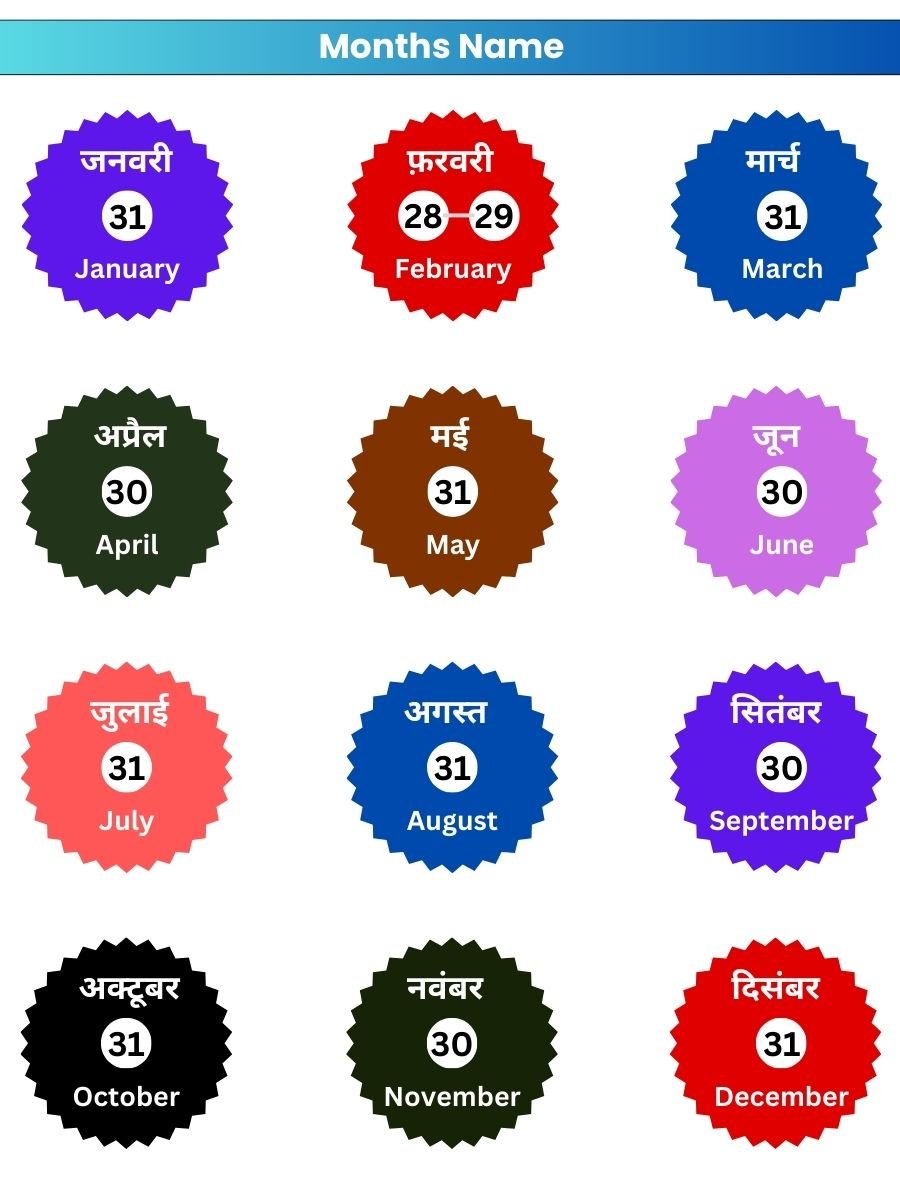
| January | (जनवरी – Janavaree) |
| February | (फरवरी – Pharavaree) |
| March | (मार्च – Maarch) |
| April | (अप्रैल – Aprail) |
| May | (मई – Mai) |
| June | (जून – Joon) |
| July | (जुलाई – Joolaai) |
| August | (अगस्त – Agast) |
| September | (सितंबर – Sitambar) |
| October | (अक्टूबर – Aktoobar) |
| November | (नवंबर – Navambar) |
| December | (दिसंबर – Disambar) |
1. January – जनवरी (Janavaree)
- Phonetics: Jah-nuh-vuh-ree
- Short Form: Jan (जन)
Description: January is the first month of the year, associated with the new beginnings and resolutions. In Hindi, January is pronounced as “जनवरी (Janavaree)” and is widely celebrated with New Year festivities.
Fun Facts
- The name “January” is derived from Janus, the Roman god of beginnings and transitions.
2. February – फरवरी (Pharavaree)
- Phonetics: Feh-bruh-ree
- Short Form: Feb (फर)
Description: February is known as the shortest month of the year, with only 28 or 29 days. In Hindi, it is called “फरवरी (Pharavaree)”.
Fun Facts
- February hosts leap years, which occurs every four years, adding an extra day on the 29th.
3. March – मार्च (Maarch)
- Phonetics: Maar-ch
- Short Form: Mar (मार्च)
Description: March marks the beginning of spring in many parts of the world. The Hindi word for March is “मार्च (Maarch)”, pronounced almost the same as in English.
Fun Facts
- March is named after Mars, the Roman god of war.
4. April – अप्रैल (Aprail)
- Phonetics: Ay-pril
- Short Form: Apr (अप्रैल)
Description: April is the fourth month of the year, associated with spring and blossoming flowers. In Hindi, it is called “अप्रैल (Aprail)”.
Fun Facts
- April Fools’ Day is celebrated on April 1st across many countries.
5. May – मई (Mai)
- Phonetics: May
- Short Form: May (मई)
Description: May is a beautiful month in which the weather often turns warmer in many parts of the world. In Hindi, May is written as “मई (Mai)”.
Fun Facts
- May is named after the Greek goddess Maia, symbolizing growth and fertility.
6. June – जून (Joon)
- Phonetics: Joon
- Short Form: Jun (जून)
Description: June is often considered the start of summer in the Northern Hemisphere. In Hindi, June is written as “जून (Joon)”.
Fun Facts
- June is named after Juno, the Roman goddess of marriage and childbirth.
7. July – जुलाई (Joolaai)
- Phonetics: Joo-lai
- Short Form: Jul (जुल)
Description: July, the seventh month, is generally one of the hottest in the Northern Hemisphere. In Hindi, it is pronounced “जुलाई (Joolaai)”.
Fun Facts
- Named in honor of Julius Caesar, who was born in this month.
8. August – अगस्त (Agast)
- Phonetics: Au-gust
- Short Form: Aug (अग)
Description: August is the eighth month of the year, typically warm and sunny. In Hindi, it is known as “अगस्त (Agast)”.
Fun Facts
- Named after Augustus Caesar, the first Roman emperor.
9. September – सितंबर (Sitambar)
- Phonetics: Sep-tem-ber
- Short Form: Sep (सित)
Description: September often marks the start of autumn in many countries. In Hindi, September is “सितंबर (Sitambar)”.
Fun Facts
- Originally, September was the seventh month in the ancient Roman calendar.
10. October – अक्टूबर (Aktoobar)
- Phonetics: Ok-too-ber
- Short Form: Oct (अक्टू)
Description: October is often known for its autumn festivals and Halloween celebrations. In Hindi, it is called “अक्टूबर (Aktoobar)”.
Fun Facts
- The name originates from “octo,” meaning eight in Latin, as it was originally the eighth month in the Roman calendar.
11. November – नवंबर (Navambar)
- Phonetics: No-vem-ber
- Short Form: Nov (नव)
Description: November is known for cooler weather and Thanksgiving celebrations. In Hindi, it is written as “नवंबर (Navambar)”.
Fun Facts
- November is derived from “novem,” meaning nine in Latin.
12. December – दिसंबर (Disambar)
- Phonetics: Deh-sem-ber
- Short Form: Dec (दिस)
Description: December is the last month of the year, known for winter holidays. In Hindi, it is “दिसंबर (Disambar)”.
Fun Facts
- The name “December” comes from “decem,” meaning ten in Latin, as it was the tenth month in the ancient calendar.
Conclusion
Knowing the months in both English and Hindi can improve your linguistic skills, making it easier to navigate calendars, plan events, or connect with people across cultures. Whether you’re studying for a language test or just expanding your vocabulary, this guide on the months’ names, phonetics, and short forms in Hindi and English will be a handy reference.
Also Read –